CONTINUING THE WORK: OXFAM CANADA’S 2024–2025 PROGRESS ON ANTI-RACISM, JUSTICE, EQUITY, DIVERSITY, INCLUSION (JEDI), AND DECOLONIZATION
CONTINUING THE WORK: OXFAM CANADA’S 2024–2025 PROGRESS ON ANTI-RACISM, JUSTICE, EQUITY, DIVERSITY, INCLUSION (JEDI), AND DECOLONIZATION
At Oxfam Canada, we believe that fighting inequality requires challenging the systems that create and sustain it. That’s why our commitment to anti-racism, JEDI, and decolonization is not a side project-it’s at the heart of everything we do.
This year marks our third update on our progress in this work. Despite many challenges, the staff and Board led significant initiatives with determination and care.
Inclusive and Accountable Leadership: Our Board’s Governance, Anti-Racism, JEDI, and Reconciliation Committee continued to oversee our progress. They actively participated in learning sessions on decolonizing the international development and humanitarian sector. Senior Leadership created a new decision-making framework clarifying how we make decisions, aiming to promote transparency and shared responsibility. The organization took part in the 50–30 Challenge, and many staff and board members participated in their training sessions. The UN Global Compact Network Canada’s Leading the Way: Inclusive Leadership in Action series featured Oxfam Canada for setting new standards in inclusive leadership.
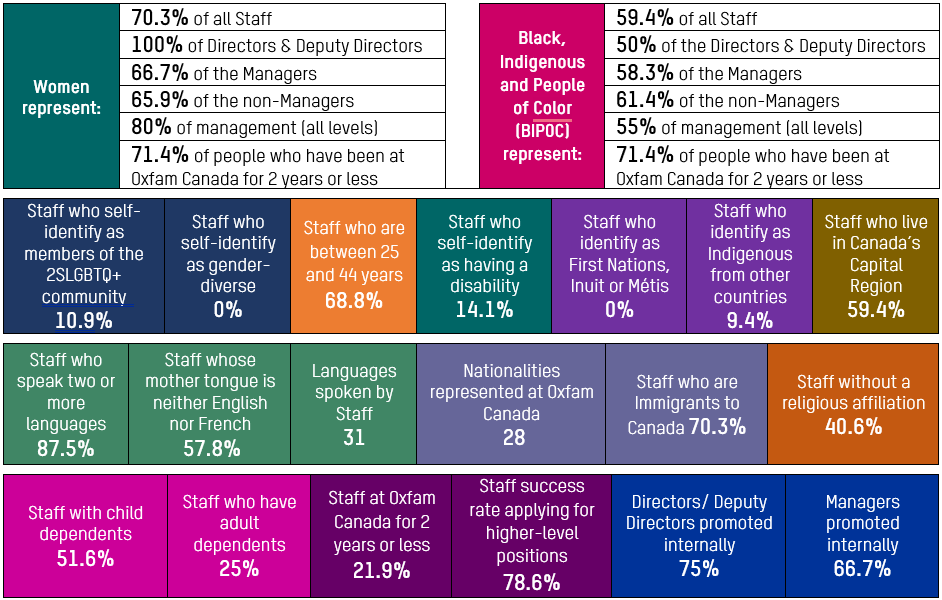
A Diverse Staff and Board: Our third demographic profile report showed we’ve made real progress in building a very diverse team. By June 2025, 70% of our staff were women. Almost 60% are identified as Black, Indigenous, or people of color (BIPOC), up from 48% in 2022. Nearly 11% are members of the 2SLGBTQ+ community. 9.4% are Indigenous from countries other than Canada. 14% identify as having a disability, up from 2.9% in 2022. 70% are immigrants to Canada, with 28 nationalities and 31 languages represented. But we know there’s more to do. We’re actively working to increase the representation of First Nations, Inuit, and Métis peoples within our team and are building relationships with Indigenous organizations to support this goal.
A Culture of Belonging: We continued to nurture a workplace where everyone feels safe, respected, and valued. That’s why we’ve continued to offer learning sessions, drop-in spaces for open conversations, and onboarding new staff on our work and strategy, including our Feminist Principles. We’ve also launched a new Staff Connectedness Strategy and a new Teaming Agreement, co-created with staff, outlining the behaviors we want to see and the initiatives we implement in our workplace to foster psychological safety and connectedness to each other and to our mission. Our individual performance evaluations continue to include anti-racism, JEDI and decolonization goals. We also continue measuring and transparently reporting on our staff's wellbeing and satisfaction, and implementing a plan to improve in the areas identified as priorities by most staff.
Diverse and Equitable Partnerships: Our work in Canada is grounded in strong, diverse partnerships to advocate for feminist and equitable policies. Through our Inclusive Child Care for All project, we continue to amplify the voices of racialized and underrepresented communities in shaping child-care policy. We provided funding to queer and BIPOC youth and community groups through our Sexual and Reproductive Health and Rights Community Support Fund. We deepened our relationship with Grassy Narrows First Nation by collaboratively piloting a gender-impact assessment toolkit. We’re also proud to be part of the Feminist Influencing Group, a coalition of feminist organizations advocating for systemic change at the federal level.
Progress towards localization and decolonization: We prioritized shifting more resources and decision-making power to our partners in the Global South. In FY25, we increased the share of unrestricted funding going to Southern Affiliates by 19% and to local partners by 7%. We’re also improving how we design and manage projects, ensuring that local organizations lead the way and receive a fair share of resources, in alignment with the global Pledge for Change initiative, of which Oxfam is a signatory.
Community-centric fundraising and communications: Our communications and fundraising work continue to evolve to reflect our values and principles better. That includes training our staff to ensure that when communicating with donors, supporters and the public, our narratives don’t reflect “white saviorism”. Instead, we focus on ethical storytelling, highlighting the leadership, resilience, and agency of our partners and the communities with whom we work. We’re using inclusive language and accessible design. We contributed to the design of an Oxfam Fundraising Proposition toolkit, reframing supporter engagement around justice, agency, shared humanity and centering systemic change and dignity.
THE ROAD AHEAD
We will keep listening, learning, and holding ourselves accountable-to one another, to our partners, and to the communities with whom we work. Dismantling systems of oppression takes time, humility, and persistence. But we are committed to doing the work, every day, to become a more just, inclusive, equitable and feminist Oxfam.
The work continues.
HIGHLIGHTS OF OXFAM CANADA’S DEMOGRAPHIC PROFILE 2025
Discover more stories
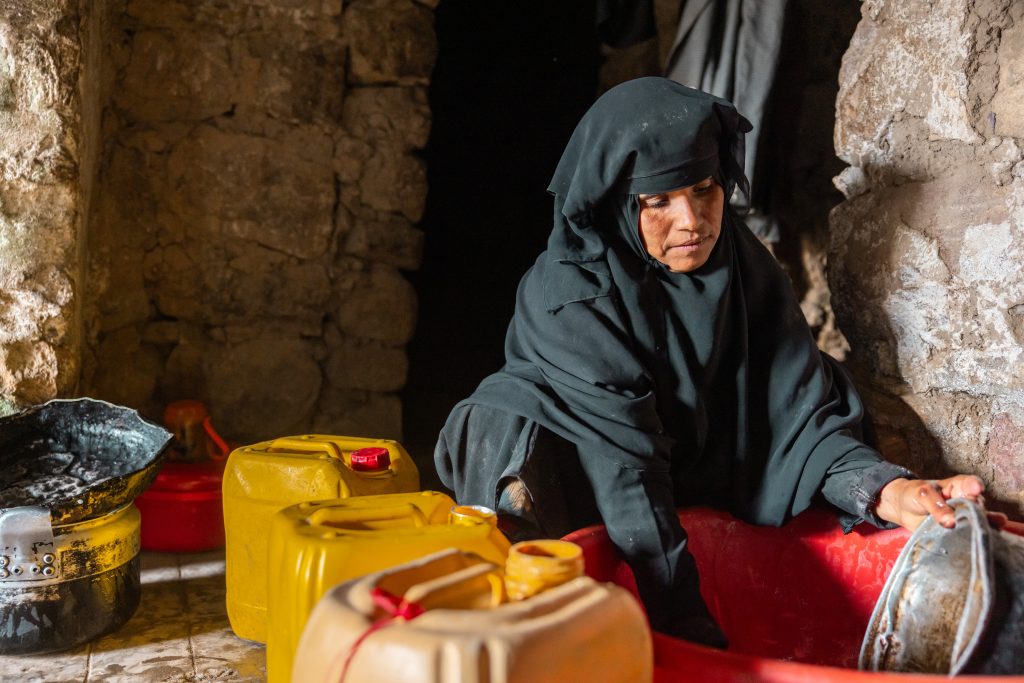
Water is a right, not a luxury. Despite that, on this World Water Day, clean water remains out of reach for millions of people. In Yemen alone, more than 17.8 million people, including 9.2 million children, lack reliable access to safe drinking water.
Women POWER (Pacific Oceanic Women Enhancing Resilience) is a five-year initiative funded by the Government of Canada and implemented by Oxfam Canada in partnership with Oxfam in the Pacific. The project works primarily in Fiji, Vanuatu and Kiribati, with regional engagement in Papua New Guinea, Tuvalu and the Solomon Islands.