Listening Over Kava: Women, Fisheries and Change in Fiji
Listening Over Kava: Women, Fisheries and Change in Fiji
During a recent visit to Oxfam Pacific in Suva, Fiji, I spent the day in discussions with colleagues on the Women Power project — an initiative focused on strengthening women’s leadership and economic resilience across the Pacific.
At the end of the day, Oxfam’s Women Power Project Officer, Varea Romanu, invited me to join her and some colleagues from the Women in Fisheries Network (WiFN), one of our key partners in Fiji, for an evening at a local kava bar.
I had heard of kava before but knew very little about it. When I asked Varea if it tasted good, she smiled and said, “No — but we will make you like it.” Intrigued, I agreed to go.
At the kava bar, I met WiFN staff member, Mili Burelevu, who welcomed me warmly and introduced me to the practice. Kava, a traditional drink made from the root of the yaqona plant, is prepared by mixing powdered root with water in a large wooden bowl. It is then shared communally, often as part of a ceremony that brings people together to talk, reflect, and build relationships. There is a rhythm to it — the clapping, the passing of the cup — that creates space for conversation and connection.
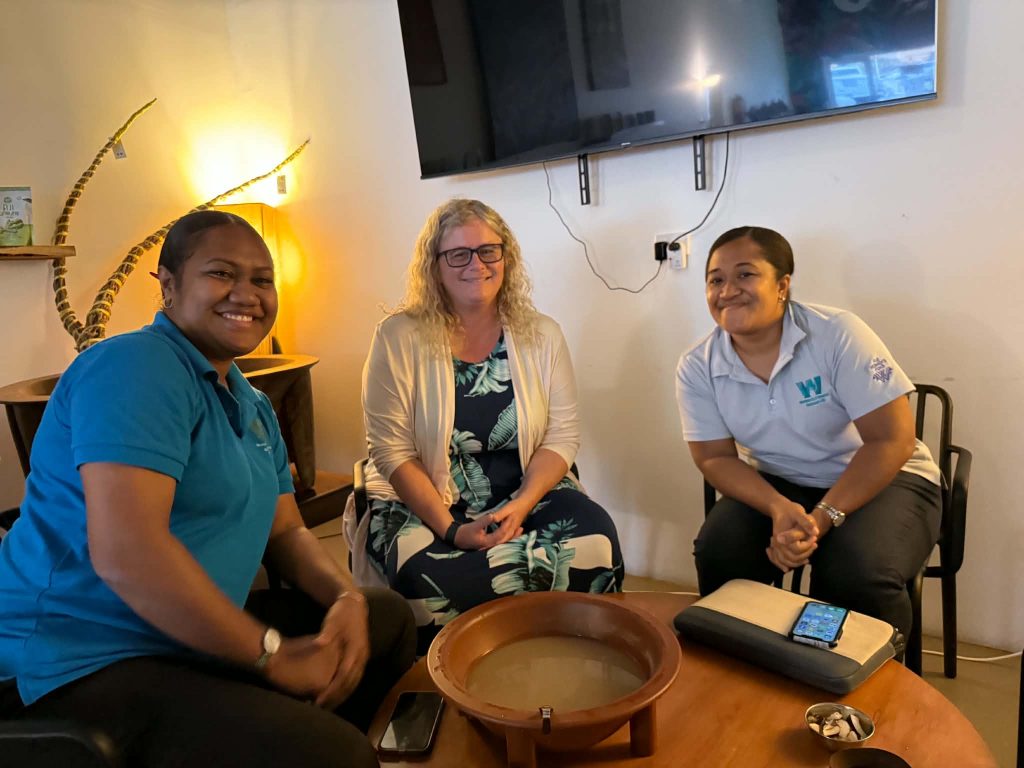
As we got to know one another, our conversation turned to the realities facing women working in Fiji’s fisheries sector.
One of the key issues raised was how social structures can shape women’s opportunities. When women marry outside of their village, they can lose social standing and influence in decision-making processes. Authority often shifts through their husband’s lineage, which can limit their ability to access resources, build businesses, or fully benefit from economic opportunities linked to fisheries and shellfish harvesting.
This dynamic can also affect who is selected to participate in trainings. When opportunities arise, such as financial literacy or seafood safety training supported through Women Power, village chiefs are often responsible for choosing participants. These decisions may favour women with higher social standing, meaning others, particularly those more marginalized, may be consistently left out.
Together, we discussed how the project might respond to these challenges. One approach could be to offer more village-level trainings, ensuring that all interested women have the opportunity to participate. As with many development initiatives, there are trade-offs: balancing costs, time, and reach, but these are critical considerations if we want to ensure that support reaches those who need it most.
Another barrier raised was the time and cost associated with accessing markets.
Women often travel long distances to sell their products, spending hours or even days away from home. WiFN is already exploring ways to support women producers in this area by strengthening connections with buyers who can purchase seafood directly within communities. This includes sustainable market entry points and connections for women-led groups, and facilitation of networking events where women fisher entrepreneurs can connect with potential buyers of seafood products.
As for the kava, I have to admit I wasn’t able to finish by the time we got to the later rounds; the taste does take some getting used to. But that wasn’t really the point.
What mattered was the space it created: an open, informal setting where we could listen, learn, and reflect together. These conversations, grounded in trust and partnership, are essential to shaping programs like Women Power, so they respond to the realities women face in their daily lives.
Because ultimately, meaningful change starts with listening.
Erin Kiley is the Director of International Programs at Oxfam Canada.
Discover more stories
The Stand Up program aims to raise awareness about sexual and reproductive health and rights across Canada by supporting community-based public engagement initiatives spearheaded by youth (aged 18 to 29) and women's rights or youth-led organizations.
For World Humanitarian Day, we're spotlighting some of the world's largest displacement crises. From Sudan and South Sudan to Bangladesh, Uganda, Syria, and Lebanon, millions of people have been forced to flee their homes while the communities hosting them face growing pressure on resources and essential services. These are not the only humanitarian emergencies Oxfam is responding to, but they show why sustained humanitarian action remains so important.